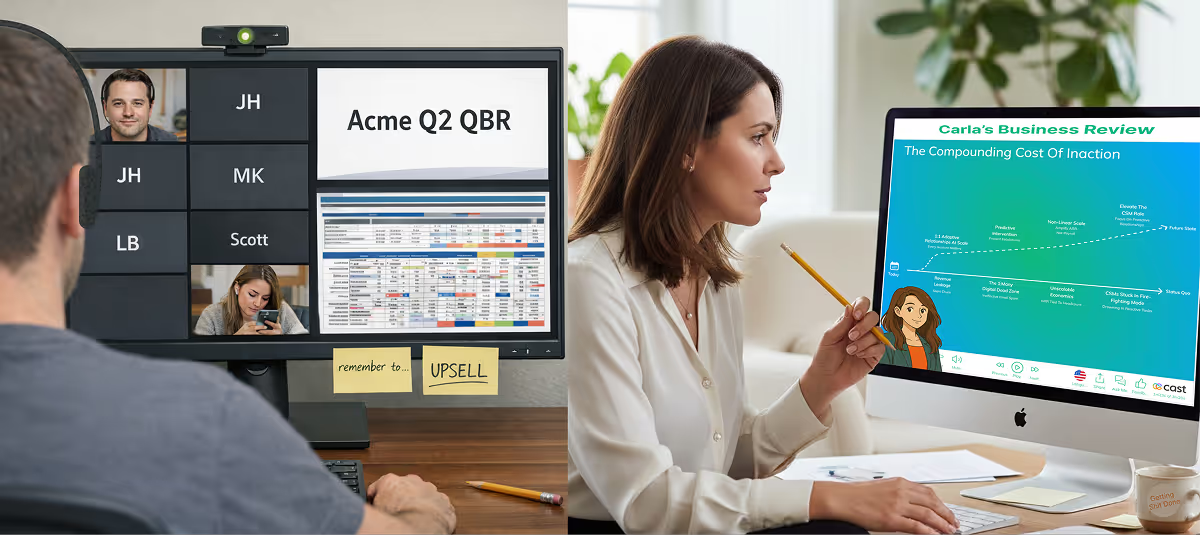
The QBR, a legacy construct, forces a generic deck to everyone over a Zoom call at Acme once a quarter. The AI Business Review delivers a personalized narrative directly to Carla, the decision-maker at Acme.
By Dickey Singh, CEO and Founder, Cast.app
The QBR’s intent was right. The quarterly, one-size format can’t keep up.
In 2026, Business Reviews become continuous, persona-aware, and agent-led—turning a retention ritual into a growth engine.
TL;DR: The Shift
- QBR Intent: Trust, alignment, and proving ROI.
- The Problem: It’s not about effort; it’s about physics. Quarterly manual meetings cannot keep pace with daily digital realities.
- The New Model: AIBR (AI Business Review). An always-on "product" created and presented by agents, capable of agent-to-agent escalation.
- The Outcome: You stop ignoring the long tail. 100% of customers get high-touch strategic reviews, surfacing expansion signals in days, not months.
Want the bigger shift beyond QBR? Read the Manifesto: Continuous Customer Outcomes
1. What a QBR was originally meant to do
Before we dismantle the Quarterly Business Review (QBR), we must respect the ritual. When Customer Success 1.0 emerged ~15 years ago (defined by the founding of customer success platforms for CSMs), the QBR was designed as the solitary bridge between vendor and customer.
It was the "Prototype for Customer Truth." At a time when data was hard to access and "Customer Success" was a new department, the QBR was the only forcing function we had to stop selling and start listening. The original "Textbook QBR" promised to:
- Force a Strategic Pause: Pull heads out of the daily support tickets to ask, "Are we actually marching toward the same North Star?"
- Translate Usage into ROI: Manually bridge the gap between "You logged in 50 times" and "You saved $50k."
- Prevent the "Silent Renewal": Create a predictable rhythm where risks were surfaced months before the contract expired, not days.
- Build Executive Equity: It was the only lever a CSM had to get a Vice President in the room to deepen the partnership.
The intent was right. The QBR served its purpose in an era where software was bought by IT and used by a few. But in 2026, where software is bought by everyone and used daily, the "Quarterly Meeting" is a container that can no longer hold the relationship. It fails today—and even the legacy CSPs have given up, claiming "QBRs are not a thing" simply because they can't scale it.
2. Why the old definition breaks in 2026
While the intent remains valid, the execution has crumbled. This isn't about effort. It's about physics. The old model fails because the "container" is broken: a rigid quarterly meeting cannot contain a continuous relationship.
The old model is failing because:
- Cadence Mismatch: Customer reality changes daily. A quarterly "rear-view mirror" meeting is often obsolete by the time it is scheduled. If Customer X realizes value on Wednesday, we shouldn't wait 12+ weeks to have a discussion about it.
- Stakeholder Explosion: You cannot serve the CFO, the Admin, and the End-User with a single slide deck. They have different goals, languages, and attention spans. Crucially, you must also inform the people behind the account—Partners, Channels, and your own Internal Leadership—so they can make the right calls.
- Manual Assembly Doesn't Scale: When humans are the bottleneck for data gathering, high-touch reviews are reserved for only the top 5% to 20% of customers. The other 80%+ are left in the dark.
- Executives Have Stopped Listening: Research shows that 72% of customers think QBRs are a waste of time. Executives report these meetings are "too long," "too tactical," and that vendors "don't do their homework." They vote with their feet by not showing up after the first one.
- Meetings Are No Longer Distribution: In a remote-first world, dragging five busy people onto a Zoom call to read slides at them is friction, not value.
The Reality: Quarterly snapshots cannot govern daily decisions.
3. The 2026 QBR Definition: AI Business Review (AIBR)
We are entering the era of the AIBR. This is not a static dashboard, and it is not a basic "chatbot." It is a fundamental shift from a "Report" to a "System"—one that executives actually want to engage with.
Definition: AI Business Review (AIBR) An on-demand, near real-time business review that is persona-aware, created and presented by AI agents (capable of speaking 18 languages to cover 98% of the global market). It features live Q&A and Agent-to-Agent "First" escalation—deflecting routine queries so decisions happen in a single session, anytime.
What AIBR is NOT:
- It is not just a "deck generator" for a human to present.
- It is not a passive dashboard that customers have to dig through.
Instead, it is an active delivery mechanism that pushes outcomes to the right people at the right time.
4. QBR vs. AIBR: The 7 Core Shifts
How does the experience actually change? The move to Cast AIBR fundamentally alters the "Physics" of Customer Success.
| Feature |
The Old QBR (Legacy) |
The Cast AIBR (2026) |
Why It Matters |
| 1. Coverage |
Top 5-20% Only.
Limited to high-touch accounts due to cost.
|
100% Coverage.
Every account (and the personas/partners behind them) gets a personalized review.
|
Scale.
You stop ignoring the "long tail" of your revenue.
|
| 2. Cadence |
Quarterly Event.
Often skipped or delayed; relies on calendar availability.
|
On-Demand & Real-Time.
Always-on, updated daily or sooner.
|
Speed.
Value is proven instantly, not 90 days late.
|
| 3. Creation |
Human Grunt Work.
CSM spends 6-8 hours manually pulling data from CRM/Portals.
|
Agent Autonomous.
AI pulls instantly from Snowflake, CRM, & Usage Data.
|
Efficiency.
Your high-paid CSMs stop doing data entry.
|
| 4. Personalization |
Account Generic.
Presents 8-15 generic recommendations to "The Account" (cognitive overload).
|
Persona Specific.
Presents 3-4 hyper-relevant actions per user. User Success is the new Customer Success.
|
Relevance.
The CEO sees ROI; the User sees workflow tips.
|
| 5. Perspective |
Rear-View Mirror.
"Here is what happened last quarter." (Lagging indicators).
|
Next-View Mirror.
"Here is what you should do next." (Prescriptive & Leading).
|
Impact.
Customers don't pay for history; they pay for outcomes.
|
| 6. Presentation |
Human Host.
Dependent on a CSM to present, explain, and manage the room.
|
AI Presenter.
The Agent does the "heavy lifting" of presenting, explaining, and answering Q&A.
|
Consistency.
A perfect, data-backed presentation every time.
|
| 7. Escalation |
Human Chain.
Support → SME → AM (Slow and expensive).
|
Agent-First.
Agent resolves questions first; only strategic items escalate to humans.
|
Focus.
Humans only solve novel, high-value problems.
|
5. Why AIBR becomes a growth engine (at scale)
Moving to AIBR isn't just an operational efficiency play—it is a P&L strategy. When you remove the friction of manual QBRs, you unlock:
- Adoption Acceleration: This goes beyond "product usage." It drives Executive Adoption of your value proposition because they receive strategic insights in their language, not just tactical metrics.
- Risk Prevention: Early signals are caught on Day 3, not Day 89. This drastically reduces "surprise churn".
- Expansion Pull: When benchmarks and value are surfaced continuously, upgrade conversations happen organically, not just at renewal.
- Partner Leverage: AI agents can deliver consistent narratives across indirect customers and partners, ensuring no segment is ignored.
The Chain of Impact:
Continuous Truth → Faster Action → Better Outcomes → Rapid Feedback Loops → Higher Retention & Expansion.
6. Lower Friction: Why this change spreads
The brilliance of the AIBR is that it is approachable. It doesn't require "re-training" your customers.
- Customers already understand the concept of a "Business Review".
- You aren't introducing a new, confusing ritual; you are upgrading a legacy 15-year-old ritual to 2026 standards.
- It meets them where they work. In addition to being available in your portal (Pull), it pushes updates via Email, Text, Slack, or Teams (Push). It is real-time, always available, and continuously updated.
7. The New Operating Loop
How does an AIBR function operationally? It follows a continuous loop that mimics a system, not a meeting:
- Ingest: The Agent ingests account context (Snowflake usage, CRM data, Support tickets, Renewal dates).
- Generate: It formulates insights and recommendations specific to the persona (e.g., "The CFO needs to see cost savings").
- Present: The review is delivered (async video or interactive brief) with a clear narrative—answering questions not covered in the static deck.
- Live Q&A: The customer asks questions ("Explain this metric," "Compare us to competitors").
- Escalate:
- Level 1: Agent answers instantly based on data.
- Level 2: If the agent hits a roadblock, it routes to Specialist Agents (e.g., Feedback Agent, Renewal Ops Agent).
- Level 3: Finally, it routes to a human CSM or Technical SME for complex strategy.
- Measure: The system constantly measures and manages the leading and lagging indicators that make up customer health, rather than relying on static scores, automatically updating the narrative.
8. What happens to the humans?
The most common fear is replacement. The reality is elevation. AIBR doesn't replace people. It restores them to higher-leverage work.
Currently, humans are stuck in the "Infrastructure" layer (Layer 3: The Factory)—building slides and assembling data. AIBR automates this "Build" phase, allowing humans to move to Layer 5: The Strategic Application.
9. Frequently Asked Questions
Are QBRs still a thing?
Even the ex-CEO of Gainsight has said, "QBRs aren't a thing." He is right about the format—manual, quarterly meetings are dead. But the ritual of reviewing business value is critical. You can't give up on it just because humans can't scale it. AIBR allows you to keep the ritual but fix the delivery.
Is AIBR just a dashboard?
No. Dashboards are passive—you have to go dig for answers. AIBR is active; it narrates a story, pushes recommendations, and answers questions that static dashboards cannot.
Won't executives just log in if the product is useful?
Be realistic. A typical enterprise uses hundreds of products (Tealium, for example, uses 128). An executive will never log into 128 different dashboards. AIBR respects their attention by pushing the insight to them, rather than waiting for them to login.
Are AI Business Reviews safe and grounded?
Yes. Modern AIBR agents use two safety layers:
- Grounded Data: They are restricted to your specific CRM and usage data.
- Confidence Scores: If confidence is mid-range, the answer is presented with caveats. If confidence is low, the Agent explicitly says "I don't know" and offers to connect you to a human.
How do I scale QBRs across thousands of accounts?
You can't with humans. You can only do it with Agents. AIBR allows you to deliver "High Touch" quality reviews to your "Tech Touch" segment.
10. The Inevitable Shift
We tried to do with humans what can only be scaled by software. In 2026, the Business Review becomes continuous, personal, and agentic. The companies that adopt this first will look like they've hired an army.
Ready for the deep dive? 👉 Read the Manifesto: Continuous Customer Outcomes: The End of the Check-In